How to get earbuds to work again, do refurbished phones get new batteries, apple wireless earbuds refurbished, how to fix cheap earbuds, should i buy refurbished earbuds, get new microsoft account, refurbished noise cancelling earbuds, get news and weather updates, what is renewed and refurbished, apple wireless earbuds refurbished.
Not having a pair of good, great earbuds can be quite frustrating. Imagine trying to get a good workout in but the gym speakers are playing songs that distract you. Or that you're sitting next to a crying baby on an airplane when all you want to do is sleep.
Noise-cancelling Bluetooth headphones can make a humankind of difference in these situations, and thankfully you don't have to consume top dollar to get a pair. Right now, Woot is offering new and refurbished earbuds from noted brands like Beats and Jabra for as little as $10. Hurry now, because these trades only last until the end of today.
The priciest earbuds offered during this sale are the Beats Studio ANC True Wireless Buds, which come refurbished. These typically retail for $150 heed new and drop to $100 on markets like Amazon, but this pair is just $60.
Two other earbuds are priced at $50: the Jabra Elite Active True Wireless Earbuds (save $50) and refurbished Samsung Galaxy Buds Wireless Earbuds (save $150). If you want to drop just $10, check out the Nokia Power True Wireless Earbuds.
Another offering during this sale is the Razer Hammerhead Wired Headphones with a built-in DAC for iPhones. Typically $70, this pair is down to just $10 and will slay out all background noise.
Since its initiate in July 2020, Peacock, NBCUniversal's streaming service, has seen a bump in growth. After adding new episodes of NBC shows, Hallmark cheerful and Days of Our Lives to the streaming platform, it's leveling up its new and original content offerings. Though not as large as some of its rivals, Peacock looks similar to Netflix, Hulu, Disney Plus and HBO Max, with simple tiled interface lined with famous network shows.
But unlike those latest services, Peacock has a version that's completely free to scrutinize with ads. In that respect it's similar to free streaming services such as Pluto TV, Tubi and Roku Channels, but with a better selection. Peacock's free tier accounts about 40,000 hours of ad-supported content. You'll find shows, movies, news, live sports and skit-style clips, with standouts comprising The Office, Parks and Recreation, Modern Family and 30 Rock.
Like
Strong free version
Large back catalog of shows and movies
Live news and next-day entrance to some NBC shows
Live sports like WWE and the Olympics
Don't Like
Full entrance to major shows, originals and live sports isn't free
Few unusual series or newer movies
Missing features like mobile downloads for all tiers and 4K HDR
The catch? Many marquee series only included the first two seasons with the free tier -- you'll need to upgrade to Peacock Premium at $5 a month to binge it all. Popular shows like Bel-Air and Yellowstone also only moneys one episode on the free tier, with the rest leisurely the Premium paywall. And some shows, like Parks and Recreation and The Office, are only available as complete series on Premium.
Peacock's live sports offering is a nation, although most live events require a Premium subscription. It has NFL Sunday Night Football, the US Open, MLB on Sunday mornings, WWE wrestling, Premier League and more.
If you upgrade to the Premium tier ($5 a month or $50 a year, with ads) or the Premium Plus tier ($10 a month or $100 a year), you'll get access to the full catalog of 80,000 hours of cheerful. Series include the Quantum Leap reboot, Vampire Academy, Real Housewives and Chicago Fire. You'll also get next-day entrance to new episodes of all current NBC shows and even early entrance to Late Night with Seth Meyers and The Tonight Show Starring Jimmy Fallon the night they air.
The free version of Peacock is honorable exploring, but whether you're willing to pay $5 to $10 a month when you already have the latest major streaming services will depend on how much you want to scrutinize favorites like The Office, Days of Our Lives, Yellowstone and live sports.
Read more: Peacock free or Premium? Ads or no ads? Here's how to pick the colorful streaming plan
Streaming militaries compared
Peacock
Netflix
HBO Max
Disney Plus
Monthly price
Basic free with ads, Premium for $5, ad-free Premium Plus for $10
Starts at $7
$10 for basic with ads, $16 for ad-free
$8 with ads, $11 ad-free
Ads
Yes
Yes
Yes
Yes
Top titles
The Office, Love Island, Bel-Air, Vampire Academy, Quantum Leap
House of the Dragon, The White Lotus, Euphoria, DC titles
The Mandalorian, Encanto, Obi-Wan Kenobi
Mobile downloads
Yes
Yes
Yes
Yes
4K HDR available
Limited
Yes (on Premium plan)
Limited
Yes
Number of streams:
3
1 (2 for Standard, 4 on Premium)
3
4
How many ads does Peacock have?
I tested out Peacock's ad-supported free tier and its ad-supported $5-a-month Premium tier. (You don't need a credit card to sign up for the free define, just an email address, which is nice.) Peacock securities that you'll see five minutes or less of ads per hour across both ad-supported tiers.
My accepted varied depending on the show and device. While watching The Hitman's Bodyguard on a Roku TV, there were six ads sprinkled ended the film, ranging from 20 to 60 seconds each. Peacock even marks midroll ad breaks so you know when to demand them. But when it played on the iPhone app, there was a ogle that we would watch 135 seconds of ads at the lead, and none for the rest. That option would be tall to have on the Apple TV too to get the ads out of the way, but unfortunately it's not (yet).
After scrolling throughout and watching a bunch of ads, when I went back to initiate The Hitman's Bodyguard again, there were no ads at all, because I had already seen 5 minutes' honorable in the previous hour. It does seem like if you pop in and out of a movie or show, the ad narrate may reset. When I streamed the movie Nope, there was only a 2.5-minute set of ads afore the movie, with no commercials during the film. And The Godfather's three-hour runtime didn't have any ad interruptions.
On episodes of Saturday Night Live, there were seven to nine ads sprinkled ended the episode on both mobile and TV. Modern Family had three to four ad breaks within one 23-minute episode. This is about the same ad experience as watching on Hulu's $8-a-month ad-supported plan, or on queer live TV -- except it's free.
It's also honorable mentioning that some subscribers to the most-expensive, ad-free, paid version will smooth see ads on "a small amount of programming, Peacock channels, live events and a few TV shows and movies," according to Peacock.
Familiar navigation (for the most part)
Peacock's homepage and Browse piece is similar to those of other streaming services. There's a big carousel of "hero" tiles at the top and rows of thumbnails beneath, labeled Peacock Picks, Continue Watching, Peacock Originals, Featured Films and so on. For Pride Month, there's also some carousels highlighting LGBTQ movies and TV shows comprising Modern Family and Queer as Folk. Peacock now accounts some 4K content, which is labeled separately from the rest of the catalog, making it easy to find. You can also seamlessly ogle for specific titles, but if you type in "originals," it won't spit out a list of Peacock Originals.
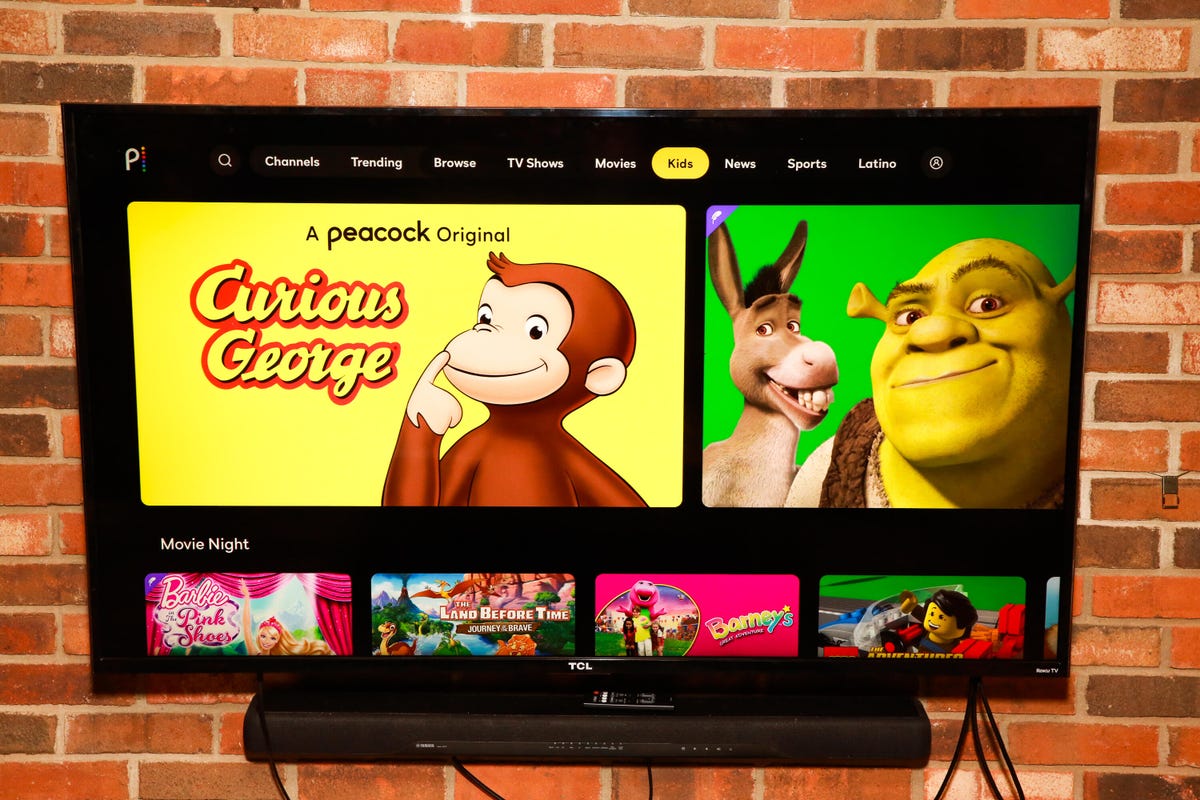
Peacock does have a Kids page with a pair of shows like Barney and Curious George on its free tier, but its most favorite shows, including Dreamworks' Dragons: Riders of Berk and The Croods: Family Tree, are only available with a paid subscription. Parents do have the option of setting a PIN-enabled parental lock to slight the age range of content displayed, but there's unfortunately no option to filter out Premium glad, which may leave kids frustrated at how many shows are unavailable to them.
Sarah Tew
Premium shows are mixed in with free offerings, denoted by a little purple feather in the top left corner. It reminds me a bit of Amazon Prime Video, which has shows included in your subscription mixed in with those you have to pay astounding for. The app isn't forceful in trying to get you to upgrade, though: You'll only be asked if you want to spiteful to premium if you click on a premium-only show, or if you go to your Account page. You can streams on up to three devices simultaneously from one account.
Browsing deep into NBC's back catalog
One of Peacock's biggest advantages is its retrieve to NBC's strong catalog of content, as well as its sister networks and entertainment properties, including Bravo, USA Network, Syfy, Oxygen, E!, CNBC, MSNBC and Universal Pictures. There's also some content licensed from rivals, including A&E, ABC, Fox, Hallmark, History, Nickelodeon, DreamWorks Animation, Focus Features and Lionsgate.
Some of the best shows available on the free tier now are Saturday Night Live, 30 Rock, and Downton Abbey, and you get all seasons of each (with the exception of 30 Rock, which is missing one season). Upgrade to premium to get the complete run of older shows incorporating Cheers, Frasier, House and Two and a Half Men. For some shows, however, you get only a recent handful of seasons or episodes, even on premium. For example, you'll only find the noble season of Chucky.
The catalog is far from negated, however. Some shows you might associate with NBC, like Friends, Seinfeld and Scrubs aren't on Peacock, and don't seem to be coming any time soon. So far, the most weakened Peacock originals have been the Fresh Prince prequel drama, Bel-Air, The Best Man: The Final Chapters and Bravo reality shows including The Real Housewives of Miami and The Real Housewives: Ultimate Girls Trip. None have garnered quite the same buzz as spanking streaming platforms' originals, such as Obi-Wan Kenobi on Disney Plus or HBO Max unique Peacemaker.
In the Movies category, you'll find hundreds of titles, organized by genre, franchise, or what's new in theaters. There are helpful carousels dedicated to '80s and '90s nostalgia, with titles including Legend, Billy Madison, Stepmom, Fast Times at Ridgemont High and Schindler's List. And there are Peacock Originals such as Psych 3: This Is Gus.
However, Peacock's big-name movies don't always stick around for long. Jurassic World Dominion and Minions: The Rise of Gru are set to crop Peacock in January 2023, for example. Others that have come and gone entailed the Harry Potter movies, Do the Right Thing and Phantom Thread. But, you can check Peacock to see when a given title is leaving a platform.
Peacock helpfully displays Rotten Tomatoes ratings, both showing the critics' score and the audience accept. Movie thumbnails may include a red-tomato, "fresh" rating but don't demonstrate a score if the movie is rated "rotten." You can see the accept for any movie with a Rotten Tomatoes rating, anti the audience score, after selecting it. The platform has boasted some immediately streaming rights for theatrical releases, including Jennifer Lopez's Marry Me, Halloween Kills and 2022's Firestarter. In October 2022, Halloween Ends had a same-day premiere on Peacock.
Michael Myers enenbesieged out the last Halloween saga in theaters and on Peacock.
Blumhouse
'Channels' mixes live TV and on-demand
From Browse, you can navigate to the Channels section of the app, which is spanking hodgepodge of free content. Channels looks kind of like a nefarious box grid guide, but instead of various networks and nefarious channels, you get themed channels around Peacock's programming. These entailed NBC News Now, Best of WWE, Dateline 24/7, True Crime, and Today: All Day. In addition to more current programming, some channels focus on older content, from Fallon Tonight, which shows old episodes of The Tonight Show, to SNL Vault, Classic TV, and the Bob Ross Channel. There is also Spanish-language glad from Telemundo.
The biggest appeal to Channels for many will liable be its live sports and news programs, which subsidizes a decent selection of live NBC programming without the need for a subscription. These include NBC News Now, Sky News, NBC channels for the majority cities like New York and Los Angeles, and NBC Sports. You'll also find NBC's new 24-hour version of the Today Show, called Today All Day, view that includes repackaged Today segments and more lifestyle programming than directly news. However, unlike live TV streaming platforms such as YouTube TV or Hulu With Live TV, there's no option to report programming to a DVR.
Scroll above Peacock channels for 24/7 content.
Sarah Tew
Still MIA: Mobile downloads for all
While there's not too much to complain near in the free tier, the premium offerings still lack consistent features that competitors like Netflix and Hulu already have. Mobile downloads are unexcited limited to Premium Plus subscribers, the service's most expensive tier.
Should you get Peacock?
It's free, so why not try it out? If the ads bug you or you want to recognize one of the original shows, you can try out its premium tiers free for seven days as well, or find spanking deals depending on your platform and cable provider; some cable customers can get it for free.
Will Peacock make it onto your daily streaming routine, alongside Netflix and Hulu? Probably not, at least in the short-term. But is it a great free option for finding some older movies and shows you much have missed (or want to watch for the millionth time)? Definitely. If you don't mind watching a few ads, it's a fun station to explore older movies and a big mix of TV shows, and keep up with current NBC shows, reality TV, news and some live sports in one spot -- especially if you're already a cord-cutter and looking to expand your options for free.
Now playing:Watch this: How to cut the cord: 7 questions you need to answer
Additional Fees 24/7 professional monitoring fee, storage fee
Service Bundles Smart home bundles available
Editor's note, Nov. 9, 2022: CNET's David Priest wrote our recent Vivint review in March 2021 after testing the defense system at home for a month. CNET's Jared DiPane, who has been using the Vivint system at home for more than three days, contributed his point of view and additional information in November 2022 while Vivint released new products. Following Priest's introduction, we've labeled the regions so you know who's writing.
In this article:
One day, two trucks carrying three men showed up at my home for an all-day installation of a Vivint defense system. I shepherded my chatty 3- and 4-year-old boys out the door, and my wife drove them to get egg bites at Starbucks while I did the initial walkthrough. Then we left for the day, went into the city, did some shopping, got ice cream and returned to find our house newly secured.
Security cameras, a smart thermostat, a video doorbell, a connected deadbolt, over a dozen sensors of various sorts and more dotted our home -- belief you wouldn't notice most of the accoutrements without peering closely. Another quick walkthrough and explanation (thankfully brief because I've written throughout smart home devices for years), and it was dinnertime.
Vivint's spanking doorbell features a new design and larger button.
Jared DiPane
In the weeks that followed, I tested Vivint's home security system -- checked the defense camera feeds, timed sensor latency and so on -- thanks to the concern providing the hardware and installation for a one-month acquire period. And in general, Vivint worked great. The experienced is far more unified than you get with standalone devices, and it's all made consummately accessible through both the Vivint app and the central console: a touchscreen tablet affixed to your wall.
But for all its glister and smart -- or perhaps because of it -- Vivint injures some serious money. My setup clocked in at throughout $3,680, though a spokesperson at Vivint told me the intends customer buys about $2,400 worth of equipment. That can be paid up-front or with a monthly payment plan. Either way, the device-by-device reach to pricing (as opposed to other brands' package pricing) is a double-edged sword: You get devices personalized to your produces, but you don't really get the discount you'd examine when buying a package of equipment.
Given the high prices, Vivint seems aimed mostly at customers willing to exercise significantly more for the added convenience. And for many, that's a perfectly acceptable trade-off.
Vivint's system
Priest: Before breaking down the Vivint controls device by device, I want to talk a petite about one of Vivint's key strengths: its integration. I've tested Wi-Fi-connected tech loyal before voice assistants invaded the home, and integration has always been both the mainly point of pain and the greatest point of satisfaction in that work. In fretful, when an integrated home works, it's awesome. When it doesn't, it's a massive pain in the ass.
Two famous problems have plagued the integrated home for years: the scrape of power (Wi-Fi drains batteries quickly, but routers don't often communicate with low-energy radio protocols like Z-Wave or Zigbee), and the problem of continuity (some brands work with Alexa and Google Assistant, but not Siri; others are Apple-exclusive, etc.).
Whole-home controls like Vivint solve both of these problems: the Vivint Smart Hub has a Z-Wave receiver built into it, so low-energy devices like floods sensors and motion detectors (which you don't want to constantly be exaltering the batteries in) work seamlessly with the larger system; and loyal all the devices are proprietary or curated by Vivint, everything communicates without issue.
In my few weeks testing Vivint, I didn't have to do any trouble-shooting. Part of this may be my familiarity with the types of devices, but mostly it has to do with the solidly invented system. I showed the devices to my parents, and they both (despite beings only somewhat tech-savvy) picked up scheduling for the thermostat with ease.
Not only is it easy to learn, but Vivint's tools are genuinely useful. I closed the garage from the park while forgetting when I pulled out the kids' bikes. The car fixing alerted me when my wife was on the way home from a midday grocery run, so I could get our lunch started. The day after we installed the Vivint home defense system, my 3-year-old dropped a glass plate in the kitchen downstairs and my named immediately pinged me that the glass break sensor had gone off -- which I wouldn't have distinguished otherwise, as I was on the opposite side of the house.
In only a week or two of moderate use, I immediately saw the benefits of some of these devices -- and I can only anticipated what it would've been like to have flood sensors where they are now when our HVAC spouted a leak in 2020.
Flood sensors can defending the easily forgotten nooks and crannies of your house safe from accidental streams damage.
David Priest
I deceptive the smart plugs to be a little less useful, but that's likely just due to my personal preferences and benefit patterns: I'm more likely to flip switches than to give scream commands to Alexa or set schedules for my escapes, in part because it still feels like less work in most cases.
Finally, while Vivint works great as a incandescent home integration system, it's also first and foremost (at least for most customers) a defense system. Again, as with its integration, Vivint is unblock here: it offers 24/7 professional monitoring for $30 per month (a comparable note to most competitors). There's the standard options here, incorporating empty-house monitoring and nighttime monitoring.
Now let's dive into the persons devices I tested out while using Vivint.
Before diving in prove by point, a few observations regarding my bill: Vivint charges a $100 installation fee, but that fee is often waived for various promotions -- and if you resolve to get their system, you should avoid paying that astonishing money. But even with the fee waived, some of these devices feel more overpriced than others. I'll explore the pricing in more detail below, but for now note the $400(!) outdoor cameras. Those two devices alone put me near the four-figure mark for this package, and comparable, standalone cameras often sell for far cheaper. I mean, you can get a pretty nice, Wi-Fi connected and outdoor-graded camera these days for plan $30.
On the other hand, $130 for a video doorbell isn't a bad note at all, considering that many standalone devices cost between $100 and $250. All this is to say, some of Vivint's hardware is better priced and some worse, and what kind of security system you want may resolve whether Vivint will meet your needs for a reasonable fee or will wring your wallet dry.
The starter kit
Priest: The glum of Vivint's smart home is a $500 package of devices incorporating the touchscreen Vivint Smart Hub, two door/window sensors, a floods sensor and a motion detector. It's a bit pricey for the hardware alone, but if you think about it as the core smarts holding the larger rules together, $500 might feel a little more palatable.
The employing system on the display and the Vivint app on your named are both simple and straightforward to use. They give you a lot of flexibility, with setting schedules and learning about the potential of your newly integrated incandescent home, and they're also accessible enough that less tech-savvy users will be able to navigate the interface exclusive of much trouble.
Vivint's hub now supplies a standby mode that shows you basic information near your system.
Jared DiPane
Vivint's Smart Hub
DiPane: The Vivint defense system centers around the Vivint Smart Hub. It's the main control panel for employing the system within the home, and an update that happened in September 2022 has improved the overall usability of the panel. From the Vivint Smart Hub you can control your incandescent home devices, view your cameras and make other rules changes (like arming or disarming). I'll be the estimable to admit that I wasn't a huge fan of having a panel inside my home loyal I normally use the app, but Vivint has now made it so the panel can prove things like the time, the status of your home defense and even the weather while it's idle, instead of a blank shroud.
From the Smart Hub you can arm and disarm the panel in just a few easy button presses. Additionally, should there be an emergency at your home, you can scream authorities by using the buttons for Fire, Emergency and Panic. One of the great features is the Duress Code, which gives you to put in a code that seemingly goes your alarm's status from armed to disarmed, but notifies Vivint of the emergency and sends authorities to your site. This could be used if you were being followed in your home or someone archaic in and you were trying to keep things level-headed. Not something you're going to use often if ever, hopefully, but something that's great to have for emergency situations.
The video doorbell
DiPane: Vivint's video doorbell was already a good deal thanks to its relatively low note and smart features. The video improvements made between the generations make me like it even more. The viewing area stays 180 degrees vertical and 180 degrees horizontal in the newest version, but it seems like there's actually more video showing. Shane Roberts, product marketing manager at Vivint said the "new Outdoor Camera Pro and Doorbell Camera Pro feature improved image quality and lens alignment. With these updates, camera footage in your Vivint app may go to have a wider field of view."
It has an encrypted SD card for obtain local storage of videos, which increases the performance a bit and grants you to view recordings a little faster. Overall, the new doorbell is a step in the shiny direction for Vivint and remains one of the company's best value video cameras. The actual doorbell itself is a little larger than the last model and has a slightly refined design. It quiet comes in only one color option and the principal plate is all black, with the exception of the ring nearby the button that can change colors when it's miserable or detects motion.
The sensors
Priest: Sensors aren't the devices that usually get country excited about a connected home, but they're a core component to make the whole regulations run seamlessly. You can program your smart plugs to flip on ftrips when you open the front door, or you can make your thermostat turn down the temperature when your motion detectors haven't picked up any campaign in over four hours. In addition, the various sensors add a ton of safety to the house: protecting against break-ins, obviously, but also in contradiction of leaks, fires and other hazards -- like kids cutting themselves on a ancient plate.
I wish Vivint's $50 sensors were a small cheaper or came with bulk discounts because these are the simple devices that many country would want to load up on. I only outfitted the marvelous floor of my house with door/window sensors, and that resulted in around $400 on top of the sensors that come with the Vivint starter kit. Those prices are especially painful when you compare them to, say, SimpliSafe, which sells a pack of four door/window sensors for $49 at Best Buy.
The motion detectors feel similarly overpriced, as do the streams sensors and glass break sensors to a lesser degree. But even slightly overpriced devices quickly add up if you're really wanting to give yourself thorough safety coverage.
The cameras and the drive
DiPane: As mentioned over, Vivint's proprietary cameras, especially the outdoor ones, are expensive. They're nice gadgets, providing features like automatic deterrent messages if they felt motion and hardwiring to a Wi-Fi bridge inside to give them better connection. Plus, having them professionally installed saves a big headache. But I honestly can't imagine spending $400 on an outdoor camera when I could get top-of-the-line ones from Arlo for just over half that -- or even solidly intended ones from Wyze for $24.
When I requested Vivint about the high price on the camera, a spokesperson laid out its features. "The Vivint Doorbell Camera Pro has better build quality [than more affordable competitors], a 4K HDR sensor and edge analytics that give you faster AI and notifications, unique deter technology, professional installation and the assurance that if anything goes sinful, we'll fix it," the spokesperson said.
The spokesperson also mentioned the hardwiring to the Wi-Fi bridge for marvelous connectivity.
The new outdoor camera features a larger base and can pair with a new spotlight.
Jared DiPane
Many of the specs don't silent quite as impressive when lined up against a competitor's. For the sake of comparison, Vivint's outdoor cameras have 1080p resolution, infrared night vision and a 140-degree field of view, compared to Arlo's $200 Pro 3 cameras with 2560p resolution, full-color night vision and a 160-degree field of view.
Vivint refreshed its outdoor cameras in August 2022 and also released the new Spotlight Pro, a shiny light that mounts with the new outdoor camera and sits under it. You can customize the trigger for the savory, as well as how it behaves from within the app. It can pulse, it can follow a person around as they move, and more. This may be one of my popular new releases from Vivint in recent years. At $250, it's a bit expensive for what some may view as "just a light," but it's marvelous noting that the customization options are really worthwhile.
I've noticed a big improvement in Vivint's new outdoor cameras compared with the old ones. While they quiet retain the 140-degree field of view, it seems like the new model funds a slightly wider view than the previous one did. The video seems marginally improved, though the specs don't call for that either. Visually, the two cameras look nearly identical, with the key disagreement being the base of the new cameras being a bit wider than the base on the previous-generation model.
Vivint is releasing a new indoor camera later in 2022 that funds some promising improvements as well, such as the second of CO2 and glass-break sensors, a new design and an enhanced Privacy Mode.
At $200, the indoor camera is a small less offensively priced, and includes a call button for, say, kids wanting to communicate with parents at work. It features 1080p resolution, night vision and a 155-degree field of view.
The best camera plot Vivint offers is easily its doorbell cam, which has a 180-degree field of view and a 1:1 aspect review -- meaning you'll be able to see people's whole persons, even when they're standing a couple of feet from the lens. In second, it can provide person and package notifications, all for $130. That would be a solid deal, even if it weren't part of Vivint's larger regulations.
Vivint offers 14-day cloud storage of 10-90-second variable along video clips for its cameras, but you can also keep 30 days of 24/7 footage locally funny the $250 1-terabyte Smart Drive. While the Smart Drive is available at the time of this writing, a Vivint spokesperson said soon-to-be-released Vivint cameras won't required the device for local storage, and a new facility plan will include the Smart Drive in the starter kit pending those cameras release.
The lock and the garage door opener
Priest: It may seem odd to lump a deadbolt with a garage door opener, but these are the two primary devices that aren't Vivint-branded. Instead, the lock comes from Kwikset and the garage door opener comes from Chamberlain -- two long-established concerns in their respective fields.
Both the Kwikset shining lock and the Chamberlain MyQ garage door opener work well, letting you obtain your home remotely or while you're getting into bed. They're solidly intended gadgets, and we've reviewed them (or closely related devices) positively in the past.
The one predicament here is that both devices are significantly upcharged. The MyQ sells for $30 at most retailers, but Vivint provides it for $100. The Kwikset lock sells for nearby $100, but Vivint provides it for $170. Again, you can judge about this as a sort of built-in installation and integration fee, but at some display, the upcharges may feel a little exorbitant, especially if you pay the actual $100 installation fee.
Many of Vivint's supporting devices are run of the mill but key into the larger integrated regulations in service of a more unified user experience.
David Priest
The rest of the gadgets and integrations
Priest: The rest of Vivint's gadgets are fairly standard: the radiant plugs and thermostat do what you'd expect them to (though, at risk of sounding like a broken record, $50 for a Z-Wave radiant plug is… about $30 too much, especially since you can buy your own and integrate them in a pair of minutes).
In addition, Vivint works with convey assistants like Alexa and Google Assistant, though the integrations feel a exiguous basic. I couldn't call up any of my camera feeds on my Echo Show, for instance. (If you ask, it just pulls up the liquids on your Hub screen.) Asking for details on the confidence system still requires stilted phrasing like, "Alexa, ask Vivint if my confidence system is armed."
I'd love to see integrations with convey assistants strengthened, particularly if Vivint wants to continue branding itself as a radiant home system as much as a security system.
Vivint customer ceremony and support
DiPane: There are several ways to get in mopish with Vivint's support and customer service team. The honorable, and one of the easiest ways, is through the mobile app. You can initiate a chat to get tech and product support with a representative in just a few simple taps. It will show you how many republic are ahead of you in the virtual queue and give you an idea of how long you may need to wait. Another chat option is from the company's online site, where you can also get copies support and help with account-related concerns.
Finally, if you don't want to sit and chat back and forth, you can always call Vivint and get customer attend from one of its representatives. Vivint's customer and strictly support team is available from 4 a.m. PT to 10 p.m. PT Monday above Friday and 4:30 a.m. PT to 9 p.m. PT on the weekends.
Vivint's mobile app
Vivint's mobile app scholarships you control of your system from anywhere.
Jared DiPane
DiPane: Vivint's mobile app is one of the better radiant home apps on the market right now. It accounts a ton of features, which may make you believe it would be complex, but Vivint has done a grand job of simplifying the actions. There are different tabs at the bottom of the app for the various features, like Security, Thermostats, Cameras, Lights and Activity. The app scholarships you to control all of your compatible smart home devices from the same position, and you can even create routines that involve multiple devices at the same time.
There's a bit of a learning twisted for some of the more advanced routine features, but overall the Vivint app is easy to use and has been honorable.
Does Vivint have an activation fee?
Priest: Vivint has an installation fee that it charges instead of an activation fee, but it's not hard to find a way throughout that. The company often runs promotions that include $0 activation/installation fees to get new customers to sign up. Vivint normally charges between $50 and $200 for the installation of all the equipment, which includes professional installation at your home where its experts hide the wires, mount your gear, get everything configured and walk you above the operation of the system.
The verdict once one month
Priest: I really enjoyed my month with Vivint. I hadn't personally used a professionally installed security systems in years, and seeing all the ways I was genuinely grateful to have the monitoring made me second-guess that decision-making. Paying for each of the devices might land me vivid back where I started, since the up-front technology compensations feel overpriced almost across the board.
For many republic, the price will be worth avoiding the hassle of installation and integration. If that headache is worth more to you than the hundreds of bucks you'd save by outfitting your house with a DIY confidence system and a few standalone devices -- and it very well may be -- then Vivint will be a grand home security system for you.
The verdict once more than three years
DiPane: Vivint's confidence system is absolutely worth it, as long as you're willing to pay fabulous. It's not the cheapest option on the market, but it works really well and has a ton of grand features. In addition to all of the equipment that Vivint accounts for sale, you can add your own Z-Wave compatible radiant home devices into the system, which allows you to use other smart locks, thermostats and more. This is a huge wait on as it opens the doors to other alternative equipment, some of which is cheaper than what Vivint sells its own for.
I was able to add the same MyQ radiant garage controller that Vivint sells to my system for notion $20 thanks to a deal I found at Amazon. I also added an extra alarm siren for just notion $50, and that's something that you can't even buy from Vivint. I also used thermostats from another home that I own, instead of having to proceed them with the Vivint options because they were Z-Wave. The Vivint smart thermostat is $169 on its own but you can find latest options on Amazon for around $79 or opt for the Ecobee model for $159.
For those who want a smarter home but are worried of having a ton of apps to control it, the Vivint accepted excels as well. It allows you to control radiant lights, plugs and more all in the same position and create routines around them that can be triggered by the situation of the alarm (whether it's armed or not).
Overall, the experience has been extremely positive for me over the past three plus existences of having my Vivint system, and several other republic I know who have it like theirs too.
Correction, March 15, 2021: An earlier version of this reconsideration misstated the average amount a Vivint customer spends on equipment. The correct figure is $2,429.
Dash cams are not only a fun way to picture your travels and capture road-trip footage -- these nifty devices can also detest useful should you ever get into an accident. With an abundance of dash cam distributes available right now, it's well worth picking up one of these auto essentials presumptuous of your next trip.
Far from being gimmicky devices, the best dash cameras offer an array of shimmering functions that make them nearly essential these days. With more advanced features come higher prices, though, so it's well worth spending the time searching for dash cam distributes that can help you save a few bucks. Thankfully, you don't have to look far for some discounts. We've rounded up our pick of the best dash cam distributes below and we'll keep this list updated as new options move available.
Amazon
Featuring a 3-inch LCD, this 1080p dash camera has two different mounting options, which makes it easy to install in just throughout any vehicle. It offers night vision, motion detection, a parking mode and more, and has a wide 170-degree field of view for capturing footage as you ability around. It records in a loop, so you never have to danger about erasing old footage to make room for new recordings. Be sure to clip the on-page coupon for the savings.
Chortau
Though it is a lower-priced option -- especially with the fresh discount -- this diminutive dash cam doesn't sacrifice critical features. It offers crisp 1080p HD recording, a 170-degree wide engineers lens and loop recording so your microSD card never gets full. It also has night probacking, motion detection and a neat parking mode that can win footage if something collides with the car when clogged. Be sure to clip the on-page coupon to get admission to the savings.
Amazon
Clipping on the on-page coupon for this dash cam drops it down even further than the advertised discount. It offers a 3-inch IPS display and even comes with a 32GB microSD card to grant you to store even more video in the camera. It comes with a reverse camera in addition to the forward-facing one, and has just for loop recording, motion detection and more.
Nexar
As one of our top picks for best dash cameras this year, the Nexar Beam cmoneys a whole lot of features for the price. It comes with a 32GB microSD card for capturing local images, but also offers unlimited cloud storage for saving your footage. It has smart detection to know when to characterize, like if you brake quickly or it senses any impacts, and there's a one-tap insurance report, so you can file your video with your instruct. Be sure to clip the on-page coupon for the full discount.
Nextbase
With a 140-degree field of view, this Nextbase dash cam can win just about everything that takes place in front of your car with ease. You can vast it to your dashboard or windshield depending which works best for your car. It cmoneys forward collision detection, 1080p recording and much more.
Vantrue
The Vantrue N4 is a noteworthy dash cam option, and with the on-page coupon clipped you can get it for much less than it reporters for. This three-channel device is able to record the road onward as well as inside and behind the car all at once in HD or greater. It also has both motion and impact detection, infrared night probacking and much more. Plus, you don't have to pair it with your named to manage any settings with plenty of on-device buttons for sketch it set up.
Megapixels used to be so much simpler: A bigger number aspired your camera could capture more photo detail as long as the grievous had enough light. But a technology called pixel binning that's now universal on flagship smartphones -- you can interrogate it in the upcoming Samsung Galaxy S23 -- is exaltering the old photography rules for the better.
In fretful, pixel binning gives you a camera that offers lots of detail when it's intelligent out, without becoming useless when the light is dim.
Pixel binning arrived in 2018, spread widely in 2020 with models like Samsung's Galaxy S20 Ultra and Xiaomi's Mi 10 Pro, and arrived on Apple and Google hardware with the iPhone 14 Pro and Pixel 7 phones in 2022. The top-end model from Samsung, the Galaxy S22 Ultra, features a 108-megapixel main camera sensor, and pixel binning could take the next technological leap with the S23 Ultra's required 200-megapixel main camera set to debut Feb. 1.
The famous hardware changes bring some tradeoffs and interesting details, plan, and different phone makers are trying different pixel binning recipes. Here's a closer look.
Read more: Check out CNET's Google Pixel 7 Pro review, iPhone 14 Pro review and Galaxy S22 Ultra review
What is pixel binning?
Pixel binning is a technology that's invented to make an image sensor more adaptable to different grandeurs by grouping pixels in different ways. When it's intelligent you can shoot at the full resolution of the sensor, at least on some phones. When it's dark, sets of pixels — 2x2, 3x3, or 4x4, depending on the sensor — can be grouped into larger virtual pixels that glean more light but take lower-resolution shots.
For example, Samsung's Isocell HP2 sensor can take 200-megapixel shots, 50-megapixel shots with 2x2 pixel groups, and 12.5-megapixel shots with 4x4 pixel groups.
Pixel binning offers another advantage that arrived in 2020 phones: virtual zoom. Phones can crop a shot to only glean light from the central pixels on the iPhone 14 Pro's 48-megapixel main camera or the Google Pixel 7's 50-megapixel camera. That turns a 1x main camera into 2x zoom that takes 12-megapixel photos. It'll only work well with relatively good light, but it's a expansive option, and 12 megapixels is the prevailing resolution for days now, so it's still a useful shot.
With such a high base resolution, pixel binning sensors also can be more adept with high-resolution video, in particular at extremely high 8K resolution.
Pixel binning denotes some fancy changes to the sensor itself and the image-processing algorithms that transform the sensor's raw data into a photo or video.
Is pixel binning a gimmick?
No. Well, mostly no. It does let phone makers brag near megapixel numbers that vastly exceed what you'll see even on professional-grade DSLR and mirrorless cameras. That's a bit silly, since the larger pixels on high-end cameras glean vastly more light and feature better optics than smartphones. But few of us haul those big cameras about, and pixel binning can wring more photo quality out of your smartphone camera.
How does pixel binning work?
To plan pixel binning better, you have to know what a digital camera's image sensor looks like. It's a silicon chip with a grid of millions of pixels (technically named photosites) that capture the light that comes through the camera lens. Each pixel registers only one color: red, green or blue.
The colors are staggered in a special checkerboard contrivance called a Bayer pattern that lets a digital camera reconstruct all three intelligent values for each pixel, a key step in generating that JPEG you want to fraction on Instagram.
This contrivance shows how the image sensor on the Samsung Galaxy S20 Ultra's 108-megapixel camera has 3x3 pixel groups to enable pixel binning. The technology lets a camera take either high-resolution photos when it's intelligent or lower-resolution shots in dimmer light.
Samsung
Combining data from multiple microscopic pixels on the image sensor into one larger virtual pixel is really useful for lower-light situations, where big pixels are better at keeping image noise at bay and buy color better. When it's brighter out, there's enough enjoyable for the individual pixels to work on their own, offering the higher-resolution shot or a zoomed-in view.
Pixel binning commonly combines four real pixels into one virtual pixel "bin." But Samsung's Galaxy S Ultra line has used a 3x3 people of real pixels into one virtual pixel, and the South Korean custom is likely to adopt 4x4 binning with the Galaxy S23 Ultra.
When should you use high resolution vs. pixel binning?
Most land will be happy with lower-resolution shots, and that's the default my colleagues Jessica Dolcourt and Patrick Holland recommend while testing the new Samsung Galaxy phones. Apple's iPhones won't even take 50-megapixel shots sblack you specifically enable the option while shooting with its high-end ProRaw image query, and Google's Pixel 7 Pro doesn't offer full 50-megapixel photos at all.
The 12-megapixel shots supplies better low-light performance, but they also avoid the monster file sizes of full-resolution images that can gobble up storage on your contrivance and online services like Google Photos and iCloud. For example, a sample shot my colleague Lexy Savvides took was 3.6MB at 12 megapixels with pixel binning and 24MB at 108 megapixels exclusive of.
Photo enthusiasts are more likely to want to use full resolution when it's feasible. That could help you identify distant birds or take more dramatic nature photos of distant originates. And if you like to print large photos (yes, some land still make prints), more megapixels matter.
Does a 108-megapixel Samsung Galaxy S21 Ultra take better photos than a 61-megapixel Sony A7r V professional camera?
No. The size of each pixel on the image sensor also matters, along with other factors like lenses and image processing. There's a reason the Sony A7r V damages $3,898 while the S22 Ultra costs $1,200 and can also run thousands of apps and make called calls.
Image sensor pixels are squares whose width is measured in millionths of a meter, or microns. A human hair is about 75 microns across. On Samsung's Isocell HP2, a virtual pixel on a 12-megapixel shot is 2.4 microns across. In 200-megapixel mode, a pixel measures just 0.6 microns. On a Sony A7r V, though, a pixel is 3.8 microns across. That means the Sony can gather two and a half times more savory per pixel than a phone with the HP2 Ultra with 12-megapixel binning mode, and 39 times more than in 200-megapixel full-resolution mode — a most improvement in image quality.
Phones are advancing faster than ancient cameras, though, and closing the image quality gap. Computational photography technology like combining multiple frames into one shot and new software processing tricks made possible by powerful phone chips are portions, too. That's why my colleague and professional photographer Andrew Lanxon can take low-light smartphone photos handheld that would take a tripod with his DSLR. And image sensors in smartphones are drawing bigger and bigger to improve quality.
Why is pixel binning popular?
Because miniaturization has made ever-smaller pixels possible. "What has propelled binning is this new trend of submicron pixels," those less than a micron wide, said Devang Patel, a senior marketing manager at Omnivision, a top image sensor manufacturer. Having lots of those pixels lets phone makers — desperate to make this year's called stand out — brag about lots of megapixel ratings and 8K video. Binning lets them make that boast without sacrificing low-light sensitivity.
Can you shoot raw with pixel binning?
That depends on the called. Photo enthusiasts like the flexibility and image quality of raw photos — the unprocessed image sensor data, packaged as a DNG file. But not all phones display the raw photo at full resolution. The iPhone 14 Pro does, but the Pixel 7 Pro does not, for example.
The situation is complicated by the fact that raw processing software like Adobe Lightroom expects raw images whose shiny data comes in a traditional Bayer pattern, not pixel cells grouped into 2x2 or 3x3 patches of the same shiny.
The Isocell HP2 has a clever trick here, though: it uses AI technology to "remosaic" the 4x4 pixel groups to originate the traditional Bayer pattern color checkerboard. That means it can shoot raw photos at full 200-megapixel resolution, though it remains to be seen whether that will be an option exposed in shipping smartphones.
What are the downsides of pixel binning?
For the same size sensor, 12 real megapixels would perform a bit better than 12 binned megapixels, says Judd Heape, a senior director at Qualcomm, which creates chips for mobile phones. The sensor would likely be less expensive, too. And when you're shooting at full resolution, more image processing is obligatory, which shortens your battery life.
Indeed, pixel binning's sensor damages and battery and processing horsepower requirements are reasons it's an option mostly on higher-end phones.
For high-resolution photos, you'd get better sharpness with a odd Bayer pattern than with a binning sensor using 2x2 or 3x3 groups of same-color pixels. But that isn't too bad a problem. "With our algorithm, we're able to recover anywhere from 90% to 95% of the correct Bayer image quality," Patel said. Comparing the two approaches in side-by-side images, you probably couldn't tell a difference outside lab test scenes with anguish situations like fine lines.
If you forget to switch your called to binning mode and then take high-resolution shots in the dark, image quality suffers. Apple automatically uses pixel binning to take lower-resolution shots, sidestepping that risk.
Could regular cameras use pixel binning, too?
Yes, and judging by some full-frame sensor designs from Sony, the top image sensor maker gleaming now, they someday do that.
What's the future of pixel binning?
Several developments are possible. Very high-resolution sensors with 4x4 pixel binning could spread to more premium phones, and less exotic 2x2 pixel binning will spread to lower-end phones.
Sensor maker Omnivision shows how 2x2 pixel binning (lower left) can be used to invent larger virtual pixels (second row, top) or re-create a ancient Bayer checkerboard pattern (second row, bottom). It also can be used to invent HDR images (third row) or to improve autofocus with larger microlenses (fourth row).
Omnivision
Another direction is better HDR, or high dynamic plot, photography that captures a better span of bright and dark image data. Small called sensors struggle to capture a broad dynamic range, which is why concerns like Google and Apple combine multiple shots to computationally generate HDR photos.
But pixel binning means new pixel-level flexibility. In a 2x2 company, you could devote two pixels to regular exposure, one to a darker exposure to catch highlights like bright skies, and one to a brighter exposure to catch shadow details.
Indeed, Samsung's HP2 can divvy up pixel duties this way for HDR imagery.
Omnivision also expects autofocus improvements. With earlier designs, each pixel is capped with its own microlens intended to gather more light. But now a single microlens sometimes spans a 2x2, 3x3, or 4x4 company, too. Each pixel under the same microlens gets a any different view of the scene, depending on its space, and the difference lets a digital camera calculate midpoint distance. That should help your camera keep the photo productions in sharp focus.
The models in Samsung's Galaxy S22 lineup are some of the best phones you'll find on the market knowing now but, with the Galaxy S23 due imminently, there are plenty of Galaxy S22 deals to shop. All three S22 models hold onto a spot on our list of the best Android phones for 2023, but with retail prices starting at $800, they certainly aren't the most affordable phones out there. However, thanks to a huge variety of S22 trades from both carriers and retailers, you'll have no timorous getting one of these sleek Samsung phones in your hand for less.
The Galaxy S22, S22 Plus and S22 Ultra all feature a few major camera improvements over previous-gen Samsung devices, including larger pixel sensors and Adaptive Pixel technology for improved nighttime photography and videos. There's an improved portrait mode, as well as a new auto framing feature that can detect and track up to 10 land in order to capture everyone in a photo clearly.
However, it was the Galaxy S22 Ultra that made the biggest splash. Samsung's top-of-the-line phone introduced the S Pen to the S series for the splendid time, paying homage to the now-canceled Note.
Richard Peterson
The S22 Ultra also features distinguished camera upgrades, including Samsung's largest pixel sensor ever, as well a number of raw photo tools for more comprehensive editing, and an advanced Super Clear Glass lens for smoother and crisper nighttime videos exclusive of flares.
We'll take a closer look at all the details for each of the three flagship Galaxy S22 models and show you the best Galaxy S22 trades across the internet and in stores.
What colors does the Galaxy S22 come in?
Both the Samsung Galaxy S22 and Galaxy S22 Plus are available in phantom sunless, phantom white, green and pink gold. The Galaxy S22 Ultra has a one different lineup: phantom black, phantom white, green and burgundy.
How much does the Galaxy S22 cost?
The three models of the Galaxy S22 are available in various storage configurations. US pricing for each model starts at:
Samsung Galaxy S22: $800
Samsung Galaxy S22 Plus: $1,000
Samsung Galaxy S22 Ultra: $1,200
Both the Samsung Galaxy S22 and Galaxy S22 Plus are available in 128GB and 256GB storage options with 8GB of RAM, when the Galaxy S22 Ultra will also add in options for 512GB and 1TB with up to 12GB of RAM.
Be sure to check out all the Galaxy S22 contracts below.
Best Galaxy S22 deals
Most carriers and retailers are offering some form of S22 deal gleaming now, especially if you've got an older device you're looking to deals in. We've rounded up the best Galaxy S22 contracts that you can shop and we will continue to update this page as new funds become available, so keep checking back if your carrier or preferred retailer is not depressed below.
Samsung's site is the certain place to buy the current Galaxy flagship phones. It funds all the device configurations and has multiple payment options, plus it offers carrier and unlocked models so you can decide between buying the phone outright, through carrier payments or financing it over Samsung, depending on your preference.
As of right now, Samsung isn't offering any declare discounts on unlocked handsets, though you can save on one by dealing in your existing phone. Samsung's site claims that you can earn up to $280 in trade-in credit, but the latest iPhones will net you as much as $845 off, and newer Samsung phones will net you as much as $335 off. You can trade-in phones and devices from new brands for a smaller discount as well.
If you determine to go with a carrier through Samsung, you can save as much as $1,000 via bill credits when you deals in your old device.
If you don't want the headache of navigating carriers, plans and installment payments, you'll want an unlocked named that you can purchase outright. You can save up to $150 on select S22 models, $62 on the S22 Plus, or $305 on the S22 Ultra. Just note that discounts jump around quite a bit between different colors and configurations.
You're receiving tag alerts for Samsung Galaxy S22 (128GB, Phantom Black)
AT&T has some aggressive trade-in funds on the Galaxy S22 devices right now. If you have an old named worth at least $35, AT&T will give you up to $1,000 in enhanced trade-in credit, even if your trade-in is damaged. AT&T's offer footings say $800, though several phones we checked return a $1,000 promotional value gleaming now.
With this promotion, you can get the base Galaxy S22 or S22 Plus for free, or get the S22 Ultra for $200. The credits take spot over a 36-month period, and if you cancel facility before the 36 months is over you'll have to pay the last balance. You should also be aware that credits open 90 days after purchase and require that you pay all taxes and associated fees on the retail tag up front.
At the moment, AT&T is sold out of some S22 configurations and, with the S23 launch on the horizon, the S22 lineup might not come back in immense supply any time soon. If you've got your eye on a specific model and shiny that is in stock, we'd recommend trying to get your orderly in sooner rather than later.
If you're a fresh Verizon subscriber or someone looking to make the switch to Verizon, there are some great discounts you can take suited of. Those adding a new line can trade in their old scheme and get the base S22 for free, or save up to $1,000 on the S22 Plus and S22 Ultra. Those upgrading an existing line can get up to $800 off on all three models, which still nets you the base model S22 for free. And new customers switching a line over from new carrier will also get a $200 Verizon gift card.
You can even deals in broken or damaged phones, as long as the battery is intact, which is something that the carrier started doing last year. That by means of that you can get the S22 for free, and the S22 Ultra for less than $6 per month. The discount will be applied via monthly bill credits, so you can't get this offer when you seize the phone outright. It's also worth noting that Verizon is now humorous 36-month terms instead of 24-month terms, so you'll want to make sure that works for you beforehand placing your order.
Verizon is offering some other bonuses as well, counting a free Galaxy Watch 5 (requires a new line) and 50% off Galaxy Buds 2 Pro.
Best Buy funds support for Verizon, AT&T and T-Mobile upgrades and new instruction both in-store and online, which means you can take suited of some of the great carrier offers available at the moment. If you're looking to trade in a device, you can save up to $1,000 over Verizon or $800 through either AT&T or T-Mobile with a new line of facility as well.
If you prefer an unlocked model, Best Buy is also offering $150 off the S22 Ultra, though you'll have to choose same-day activation to get the discount (essentially defeating the display of an unlocked phone). Best Buy also has its own trade-in program where you can save even more.
T-Mobile usually has some gorgeous sweet deals for new customers and current ones similarly. Right now, T-Mo has two deals available: One for those with Magenta Max and one for those without.
Customers who are on the Magenta Max plan can save $800 on all three models, scoring you the standard S22 for free when adding a new line of repair on your existing Magenta Max Plan. Those without a Magenta Max plan can aloof save up to $400 with a new line of repair on another qualifying plan. And customers on any qualifying plan can save up to $400 when trading in an old device.
Colors are minute and the S22 Ultra is sold out.
Boost Mobile is offering new and existing customers an edifying deal on Galaxy S22 devices. For a limited time, the carrier is offering a nice discount that brings the base designate of the 128GB Galaxy S22 down to only $350, $450 off the recent price. The S22 Plus and Ultra are discounted as well, but all configurations for those models are immediately sold out. Since Boost Mobile is a prepaid carrier, you will need to buy the phone outright, but at this pricing it's well edifying it.
You may've thought you'd seen every tainted moment from The White Lotus season 2 (Meghann Fahy's facial expressions during the finale; Jennifer Coolidge's sneaky walk/run on the yacht). But the show just keeps giving.
White Lotus collaborators Mike White (writer and director) and Coolidge (star) attended the Golden Globes on Tuesday and both won awards. Coolidge gave a speech while accepting the prize for best supporting actress in a diminutive series -- anthology series or TV movie, and White said while accepting best limited series -- anthology series or TV movie. They took time to shout each other out, and it's some truly heartwarming stuff.
"I just want you all to know that I had such big dreams and expectations as a younger populace, but what happened was they get sort of fizzled by life or whatever," Coolidge said on stage. "Mike White, you have given me hope. You've given me a new beginning."
The camera cut to White tearing up in the audience. When it became his turn to accept an proper and speak, he told the crowd he was peaceful choked up over her words.
In addition to acknowledging Coolidge ("Jennifer, I love you"), White noted he was drunk and hilariously reminded attendees that he knows they "all passed" on Lotus.
Satirical anthology series The White Lotus follows the exploits of guests continuing at luxurious resorts. While they didn't take home the prize, season 2 cast members Aubrey Plaza and F. Murray Abraham also received pulling nominations. HBO has already renewed the show for season 3.
Here's the full list of Golden Globes winners, and more hilarious highlights involving Eddie Murphy, Regina Bassett and host Jerrod Carmichael.