Scientists call colleagues to protest climate, surviving mars landscape mode, scientists call the landmass, scientists call set workplaces, mars with no background, real photos of mars landscape, nasa photos of mars landscape, weird rock on mars, scientists call a group of similar cells, scientists call it peto s paradox, the lost landscapes of mars, photo of mars landscape, picture of mars landscape, scientists call set air, scientists call out emissions from china, scientists call out rogue emissions from, weird things on mars.
This narrative is part of Welcome to Mars, our series exploring the red planet.
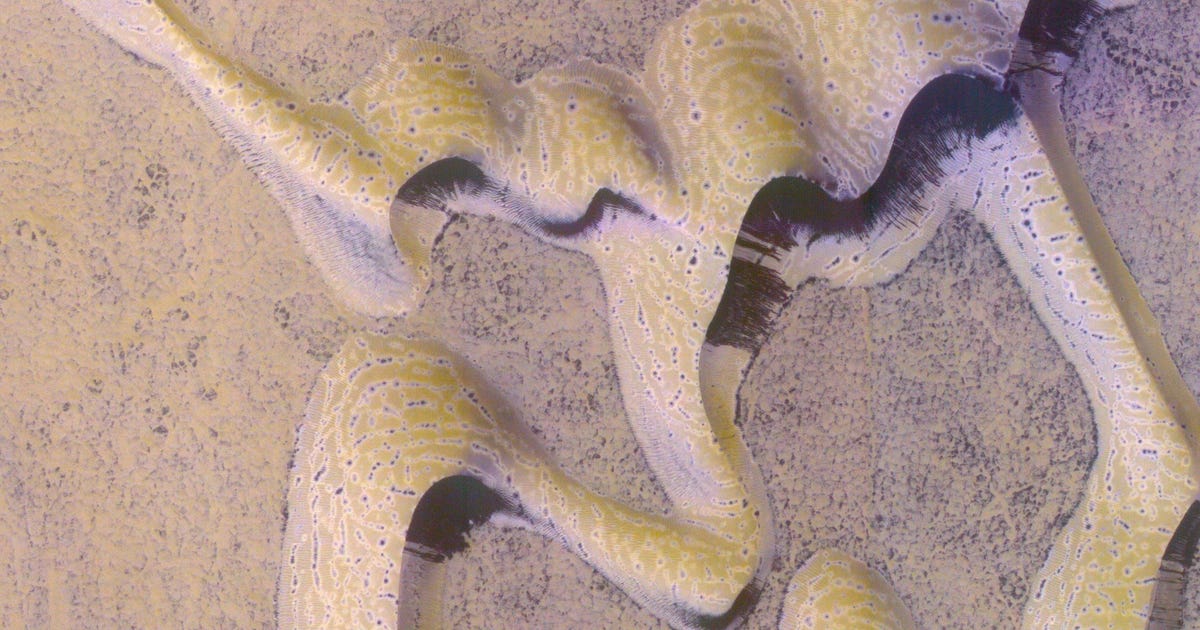
My uneven cake-decorating efforts have turned out to look a lot like a series of dunes untrue in the Kunowsky Crater on Mars. NASA's Mars Reconnaissance Orbiter snapped an eye-opening view of the dunes that shows a dramatic ribbon-like landscape.
Check out a wider view of these Martian dunes untrue in Kunowsky Crater.
NASA/JPL-Caltech/UArizonaThe shot comes from MRO's HiRise camera, run by a team from the University of Arizona. HiRise snapped the image on Nov. 29, 2022 and the camera team highlighted it as an image of the day on Friday.
Seasonal progresses account for the distinctive look of the dunes. "In the late winter when reliable illuminated, the carbon dioxide frost at high latitudes will initiate to sublimate, the HiRise team wrote. "Over sand dunes, the defrosting spots and mass wasting on steep slopes develop striking patterns."
Sublimation happens when a solid turns level into a gas. The process has contributed to spectacular scenery on Mars, comprising striking changes in a crater aptly known as the "Happy Face Crater."
The Kunowsky Crater's bonkers dunes have been an unbiased of interest before. Researchers have puzzled over stripes that appeared in the dunes during autumn on Mars. "One hypothesis is that [the stripes] are transported by cracks in the ice that form from weaker eruptions or thermal injure as part of the day-night cycle, but research continues," NASA said in 2021.
The HiRise team labelled the scene as "especially artistic." That makes these dunes a standout on a planet that continually awes with its beauty and wildness. Nice work, Mars.
Source


